Children's mental health
When you are worried about a child, it can be hard to know where to begin. Start with how their days feel, what has changed and what helps them feel understood. You can ask for support without having a name for the problem.
Start with the child, and the life around them.
Feelings and behaviour change as children develop. A concern needs context: their age, how long it has been happening and the effect on relationships, learning or everyday life.
A professional can consider health, development and what is happening around the child. There is no single online score that explains the whole picture.
Based on National Institute of Mental Health
Listen. Understand. Find support.
- The child's voice
Words, play and other ways of communicating
- Everyday context
Home, learning, friendships and health
- Supporters' views
Examples from people who know the child
- The next step
Age-appropriate professional advice
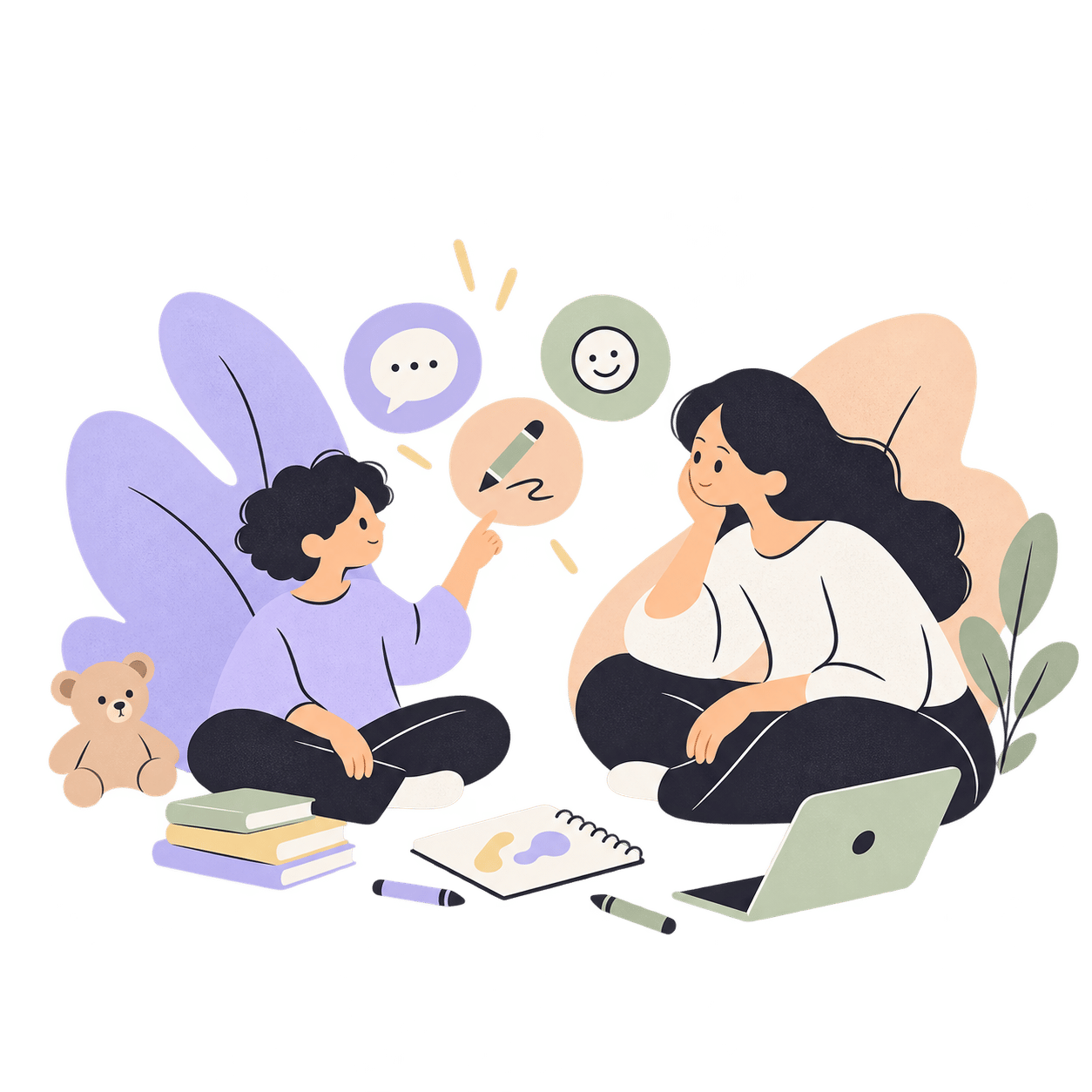
Make space for how your child communicates.
A conversation can happen alongside play or an ordinary activity. Leave room for pauses and another trusted listener. You do not need a diagnostic label to ask for help.
Choose the topic that matters to you.
These sections help you find information. Choosing one does not suggest a diagnosis.
- Information for teens
A separate starting point written directly for young people.
- Autism in children
Understand developmental assessment, communication and support.
- ADHD in children
Explore attention, activity and context across different settings.
- Trauma in children and teens
Explore support without asking a young person to retell an event.
- OCD in children and teens
Understand distress, rituals, assessment and age-appropriate care.
- Help a child feel heard
Find a way to listen without pressure to explain everything.
- Ask for the right support
Prepare examples and understand what happens next.
Notice changes with curiosity.
One example from an ordinary day can help you explain your concern. These areas give you a starting point for a conversation, not a checklist for a diagnosis.
Daily patterns
Changes in sleep, eating or energy compared with the child's usual pattern.
Feelings
Worries, sadness or irritability that seem difficult to manage.
Everyday life
Finding friendships, school or familiar activities harder.
Their communication
What the child says, shows through play or communicates in another way.
Based on National Institute of Mental Health · NHS
Different settings can tell different parts of the story.
Ask what feels difficult and what helps at home, in education and with other people. Differences between accounts are useful context; one person’s report does not cancel another’s experience. Include interests, strengths and communication needs.
A child assessment brings different perspectives together.
A qualified professional may talk with the child and supporters, review development and health, and seek relevant school information. Explain which situations are difficult and which help; a child may feel different across settings.
Ask how the child will be included, which age-appropriate assessment is proposed and what happens afterwards. A parent, teacher and young person's questionnaire each represents a different perspective.
Based on National Institute of Mental Health · NHS
- 1Their day
What feels harder, and where does the child seem comfortable?
- 2Their voice
What has the child told or shown you in their own way?
- 3Your question
Ask what support is appropriate and how the child will be included.
Ask who will bring the information together.
A child health professional can help coordinate developmental, physical and emotional concerns. Ask what information is useful, why it is needed and how the child will take part. You do not need to upload school reports or private histories here.
A referral should come with a next-step question.
Ask who to contact while waiting, what help education or healthcare can offer now and what to do if needs change. Service names, school arrangements and access rules differ by location; NHS links describe England.
Involvement can change as your child grows.
Ask how the service supports increasing independence, communication preferences and privacy. Explain information-sharing limits in a way the young person can understand, rather than promising secrecy or assuming every conversation belongs to adults.
- For teenagers: your own starting point
Direct explanations of asking for help and questions about privacy.
- When speaking is difficult in some settings
Communication support without pressure to perform.
Make room for the way they communicate.
Some children find feelings easier to show through play, drawing or shared activity than a direct conversation. Offer attention and time, rather than turning the moment into a test. Another trusted adult may also help them feel comfortable.
If a child tells you about abuse or harm, take them seriously and seek appropriate safeguarding help. Do not promise to keep a safety concern secret or repeatedly ask them to retell what happened.
Based on NHS
Prepare for a conversation about support.
Bring a few examples of what you have noticed, when it happens and how it affects the child's day. Include strengths and things that help. You can ask the service how they involve children and supporters, what happens while waiting and who to contact if safety changes.
You do not need to ask the child to complete an adult questionnaire first. If a professional suggests a child measure, ask which form is intended, who answers and how the information will guide support.
Based on National Institute of Mental Health · NHS · NHS
Autism in children: understand their way of experiencing the world.
Autism is a difference in development that can involve communication, sensory experience, routines and interests. Autistic children have different strengths and support needs; a child does not need to show every example you have read about.
A child assessment can bring together developmental and health history, observation and information from people who know the child. Tell the team what helps communication and what is difficult in everyday settings. An online trait score cannot replace that process.
You can discuss comfort, communication and practical support while seeking advice. Ask about surroundings, changes in routine and support in education, alongside the things the child enjoys. The purpose is to understand and support the child.
M-CHAT-R/F is a two-stage, age-limited developmental screening tool used with a parent's report. It is not a test for every child, and a positive screen is not an autism diagnosis. Ask the child's professional which assessment fits their age and needs.
Ask which communication, sensory or learning adjustments would help now, including while assessment is pending. Build on the child’s interests and preferred ways to participate; support is broader than changing how a child appears to other people.
Assessment builds a developmental picture.
- Development
How communication, play and everyday skills have developed
- Observation
How the child communicates and engages in a suitable setting
- People who know them
Relevant home, nursery or school perspectives
- Support needs
Strengths, sensory comfort and what makes daily life easier
Where M-CHAT-R/F fits
A parent-report developmental screen with an age-specific protocol and structured follow-up. It does not cover every child or replace an autism assessment.
Ask which assessment is appropriate for this child's age, communication and circumstances.
Based on M-CHAT / Diana Robins · Robins, Fein & Barton / M-CHAT
Based on NHS · NHS · NHS · M-CHAT / Diana Robins · Robins, Fein & Barton / M-CHAT
ADHD in children: look across their everyday settings.
An ADHD assessment considers attention, activity and impulsivity in the child's developmental context. Sleep, learning, anxiety and other health concerns may also need consideration; there is no single test that diagnoses ADHD.
Professionals seek information from parents, teachers and other relevant adults about different settings. Describe when a difficulty happens, how it affects the child's day and what support changes it. Different accounts can add context rather than being averaged into one answer.
NICHQ Vanderbilt scales have separate parent and teacher forms, including different initial and follow-up versions. The owner resource describes use for children aged 6–12. They are part of professional assessment, not the adult ASRS or a standalone diagnosis of ADHD, ODD or conduct disorder.
Ask which support fits the child's age and needs, how home and education can be involved and how progress will be reviewed. Treatment may include behavioural support and, where appropriate, medication discussed with the child's clinician.
Bring examples of both difficult and manageable settings, and ask what makes participation easier. Involve the child in identifying useful support. An adult questionnaire or a compliance score cannot replace a child-focused assessment.
Different settings add different information.
- The child's experience
How everyday demands feel to them
- Home
Examples from routines and relationships
- Education
Learning, attention and support in that setting
- Wider health
Development, sleep, learning and other possible explanations
Based on Centers for Disease Control and Prevention · Centers for Disease Control and Prevention
Where Vanderbilt forms fit
Separate parent and teacher ratings can inform a professional assessment. Initial and follow-up forms have different purposes; neither is an adult ASRS or an independent diagnosis.
Ask who completes each form, which edition is intended and how the information will guide support.
Based on National Institute for Children's Health Quality · NICHQ / American Academy of Pediatrics
Based on Centers for Disease Control and Prevention · Centers for Disease Control and Prevention · National Institute for Children's Health Quality · NICHQ / American Academy of Pediatrics
Trauma in children and teens: start with safety and support.
A frightening or dangerous experience can affect a young person's feelings, sleep, concentration, behaviour or sense of safety. Responses vary with development and circumstances. Experiencing trauma does not mean that a child necessarily has PTSD or complex PTSD.
You can make space for the child to talk, write or draw when they are ready, while keeping familiar routines where possible. Do not press for a detailed account or promise that everything will be fine by a particular time. Seek professional help when you are concerned about their wellbeing or daily life; you do not have to wait for a score.
A trauma-informed assessment considers current needs, strengths, safety and family or community context. Ask how the young person will be included and what support is available. This page does not ask you or a child to describe an event.
The ITQ-CA is a child and adolescent measure of ICD-11 PTSD and complex PTSD symptoms; the owner describes ages 7–17 and a separate caregiver version. Neither is simply the adult ITQ renamed. A questionnaire's purpose, exact form and support afterwards should be explained by the professional using it.
Support can begin with present safety, predictable care and a trusted listener. Do not require a detailed retelling to take a concern seriously. Ask a child specialist how to explain the purpose of assessment and respond to safeguarding concerns.
Support starts with their present needs.
- Safety now
Current needs and appropriate help
- Their own pace
Room to communicate without pressure
- Everyday life
Sleep, learning, relationships and strengths
- Appropriate support
A developmentally informed professional plan
Based on National Institute of Mental Health · National Child Traumatic Stress Network · National Child Traumatic Stress Network
Where child trauma questionnaires fit
ITQ-CA concerns ICD-11 PTSD and complex PTSD symptoms in a defined child/adolescent age range. The young-person and caregiver forms are separate perspectives; neither is an adult form with a changed title.
Ask which exact form is suitable and what support follows. You do not need to complete a questionnaire or recount an event here.
Based on Trauma Measures Global
Based on National Institute of Mental Health · National Child Traumatic Stress Network · National Child Traumatic Stress Network · Trauma Measures Global
OCD in children and teens: look at distress and everyday impact.
OCD can involve unwanted, distressing thoughts and repeated actions or mental rituals. A young person may find the experience hard to describe or hide it because they feel ashamed. An assessment needs their perspective as well as relevant caregiver information.
Describe what is taking time or making ordinary activities difficult, without requiring the child to disclose every thought to you. An experienced professional can consider OCD alongside other explanations. Repeated behaviour alone does not establish OCD.
Treatment may include developmentally appropriate exposure and response prevention, a form of cognitive behavioural therapy delivered by a trained professional. Medication may also be discussed when appropriate. Ask how supporters can help and how the plan will account for school and daily life.
The OCI-CV-R is a revised child self-report symptom measure, distinct from the original OCI-CV, the shorter OCI-CV-5 and adult OCI-R. CY-BOCS and CYBOCS-II are clinician-administered assessment references, rather than interchangeable child self-tests. Ask which version is proposed and why; a questionnaire result does not replace a full assessment.
Explain how worries or rituals affect ordinary activities and family life without making the child prove or defend them. Ask how trained care will involve the child and supporters. Exposure work needs an appropriate professional plan, not tasks improvised from this page.
Understand the experience and its impact.
- Their experience
What feels distressing or hard to explain
- Time and disruption
Effects on ordinary activities
- Different perspectives
Child and caregiver accounts in context
- A treatment plan
Appropriate professional care and support
Based on International OCD Foundation · International OCD Foundation
How OCD assessment measures differ
OCI-CV-R is a revised child self-report symptom profile. Original OCI-CV, OCI-CV-5 and adult OCI-R are distinct. CY-BOCS and CYBOCS-II need clinician administration and are not child self-tests.
Ask which version is proposed, how it fits a full assessment and how supporters will be involved.
Based on Abramovitch and colleagues / Journal of Anxiety Disorders · International OCD Foundation
Based on International OCD Foundation · International OCD Foundation · Abramovitch and colleagues / Journal of Anxiety Disorders · International OCD Foundation
You deserve to understand your care.
The child you support deserves to be heard in a way that works for them.
Understand the appointment
Find support. Prepare your next step.
Find care or prepare a conversation. You can ask for help before you have a diagnosis.
Your first sentence does not need to be perfect.
You might begin by making time alongside an activity the child enjoys. Listen without pressing them to explain everything. A primary-care professional or an appropriate school contact can help you discuss your concerns.
“I am concerned about a child I support. I would like help understanding what has changed, how they can be heard and which support may fit.”Prepare for the appointment
Your questions, with room for nuance.
You can read just the answer you need.
Do we need to know which condition this is?
No. Start with a change, its impact and what the child wants someone to understand. A professional can help clarify the concern.
Based on NIMH
What if school and home see different things?
Tell the professional about both accounts and the child’s perspective. Context matters; reports are not a vote or a score to average.
Can we ask for help while waiting?
Yes. Ask the referring service or child health professional about available support and a contact if things change. Immediate safety concerns need urgent help.
Will I attend every conversation?
Arrangements depend on the young person, service and local rules. Ask about involvement, private time and when information may need to be shared.
Based on NHS
Where this information comes from.
Use this hub to learn and prepare questions. It does not diagnose you or recommend a personal treatment plan. By Selfmora editorial; sources checked . Updated .
Additional explanations and examples: sources consulted . Examples illustrate ideas; they do not assess your personal health. Your questions
- Children and mental health: recognizing concerns and getting help
- Talking to your child about feelings
- Where to get mental health support as a young person
- What happens when a young person's needs are assessed
- Receiving mental health support as a young person
- Autism assessments, including children
- Signs of autism in children
- Supporting an autistic child
- Diagnosing ADHD in children
- ADHD treatment across ages and settings
- M-CHAT-R/F owner guidelines and permissions
- M-CHAT-R/F: March 2025 terminology update and use instructions
- NICHQ Vanderbilt Assessment Scales: editions and child context
- Original NICHQ Vanderbilt parent, teacher and follow-up forms
- Helping children and adolescents cope with traumatic events
- About child trauma
- Trauma-informed mental health assessment
- ITQ-CA: owner population, informants and public-domain statement
- Assessing pediatric OCD
- Treatment for pediatric OCD
- The OCI-CV-R: original revision study and appendix
- Preparing a training case: clinician-administered CY-BOCS and CYBOCS-II